

Music played a significant role in ancient Greek society, weaving through religious ceremonies, theater, education, and private entertainment. The instruments of ancient Greece reflect the culture’s ingenuity, artistic expression, and technical skills. These instruments can be broadly categorized into three groups: stringed instruments, wind instruments, and percussion instruments. Each had distinct characteristics and uses, forming an integral part of Greek life.
- Stringed Instruments
Lyre
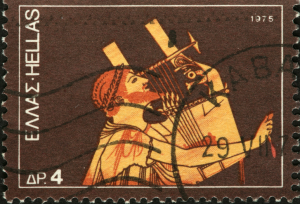
The lyre is perhaps the most iconic Greek instrument, associated with the god Apollo, who symbolized music, prophecy, and poetry. The lyre typically had a tortoiseshell body, with arms made of wood. Animal gut strings, stretched between a crossbar and the resonating body, were played with a plectrum or plucked by fingers.
Sound and Role:
The lyre produced a soft, melodic sound, ideal for accompanying poetry recitations, personal entertainment, and education. It symbolized order and harmony and was a staple in musical training for young Greeks, especially in aristocratic households.
Kithara
The kithara, a larger and more elaborate cousin of the lyre, was a professional instrument often used by musicians and performers in public settings. Its construction involved a wooden resonating body and a more complex structure of strings, allowing for greater tonal range and dynamic expression.
Sound and Role:
With a louder, more resonant tone than the lyre, the kithara was prominent in festivals, competitions, and performances, especially in theatrical and civic contexts.
Barbiton
The barbiton was a deep-sounding stringed instrument, longer than the lyre, and associated with the Muses and love poetry. It had a languid, mournful tone and was favored in leisurely or romantic settings.
Sound and Role:
Its melancholic sound made it suitable for poetic or emotional compositions and was often used in private gatherings.
- Wind Instruments
Aulos
The aulos was a double-reeded instrument made from materials such as wood, bone, or ivory. It featured two pipes that could be played simultaneously, creating a rich, layered sound. The aulos was associated with the god Dionysus, symbolizing ecstasy and revelry.
Sound and Role:
The aulos produced a piercing, dynamic sound, suitable for energetic and dramatic occasions. It played a central role in religious rituals, particularly those honoring Dionysus, and accompanied theatrical performances, such as tragedies and comedies. It was also integral to military marches and athletic events, such as those at the Olympics.
Syrinx (Pan Pipes)
The syrinx, or panpipes, consisted of a series of hollow reeds of varying lengths bound together. Blowing across the open tops produced melodic tones. The instrument is tied to the pastoral god Pan and was often played by shepherds.
Sound and Role:
The syrinx emitted a soft, ethereal sound, evoking natural settings. It was used in pastoral settings, religious rituals, and as a symbol of rustic simplicity.
Salpinx
The salpinx was an early trumpet made from bone, bronze, or ivory, with a straight design and a bell-shaped end. It was blown using a mouthpiece.
Sound and Role:
The salpinx produced a loud, commanding sound and was primarily used in military contexts to signal commands during battle or announce events in public gatherings.
- Percussion Instruments
Tympanon (Drum)
The tympanon was a handheld drum, typically circular, with a stretched animal skin membrane. It was struck with hands or sticks to produce rhythm.
Sound and Role:
The tympanon had a rhythmic, resonant sound, frequently used in Dionysian rituals and ecstatic celebrations. Its steady beat underscored dances and choral performances.
Krotala
Krotala were wooden or metal clappers, resembling castanets. These small percussion instruments produced sharp, rhythmic sounds.
Sound and Role:
Krotala were often played during dances or in theatrical contexts, serving as both rhythm keepers and dramatic sound effects.
Cymbals
Bronze cymbals, small and handheld, were another popular percussion instrument. They were struck together to produce a metallic ringing sound.
Sound and Role:
Cymbals were used in religious rituals and celebrations, particularly those honoring Dionysus and Cybele, often accompanying ecstatic dances and hymns.
Occasions for Music
Music permeated nearly every aspect of ancient Greek life. Each instrument had its own purpose and cultural significance.
- Religious Rituals:
Music was central to Greek religious ceremonies. Lyres and auloi often accompanied hymns to the gods, while percussion instruments like tympanons enhanced the fervor of Dionysian celebrations. - Theater:
In Greek drama, the aulos was essential in setting the mood for tragedies and comedies, helping to convey emotional depth and highlight dramatic action. - Education:
Learning to play the lyre or kithara was part of a young aristocrat’s education, fostering discipline and cultural refinement. - Home Entertainment:
In private settings, lyres, barbitons, and syrinxes entertained families and guests, often accompanying storytelling or poetry recitation. - Military and Civic Events:
The salpinx and aulos were indispensable in military parades and athletic events, inspiring courage or marking key moments.
Cultural and Historical Significance
Greek musical instruments were not just tools for entertainment but symbols of divine inspiration, education, and cultural identity. Many instruments, such as the lyre and aulos, were believed to have mythological origins, often credited to gods like Apollo or Athena. They were seen as channels connecting mortals with the divine.
Greek music and instruments significantly influenced later cultures, including the Romans, who adopted and adapted many Greek instruments. The philosophical writings of figures like Plato and Aristotle underscored the ethical and educational roles of music, shaping its place in Western tradition

